
Customs clearance at Los Angeles and Long Beach
Two adjacent ports run as separate authorities, handling the largest container volume in the country. Scale is the whole story here, in both directions.
Licensed U.S. customs brokerage. Customs broker of record; movement coordinated through vetted partners.
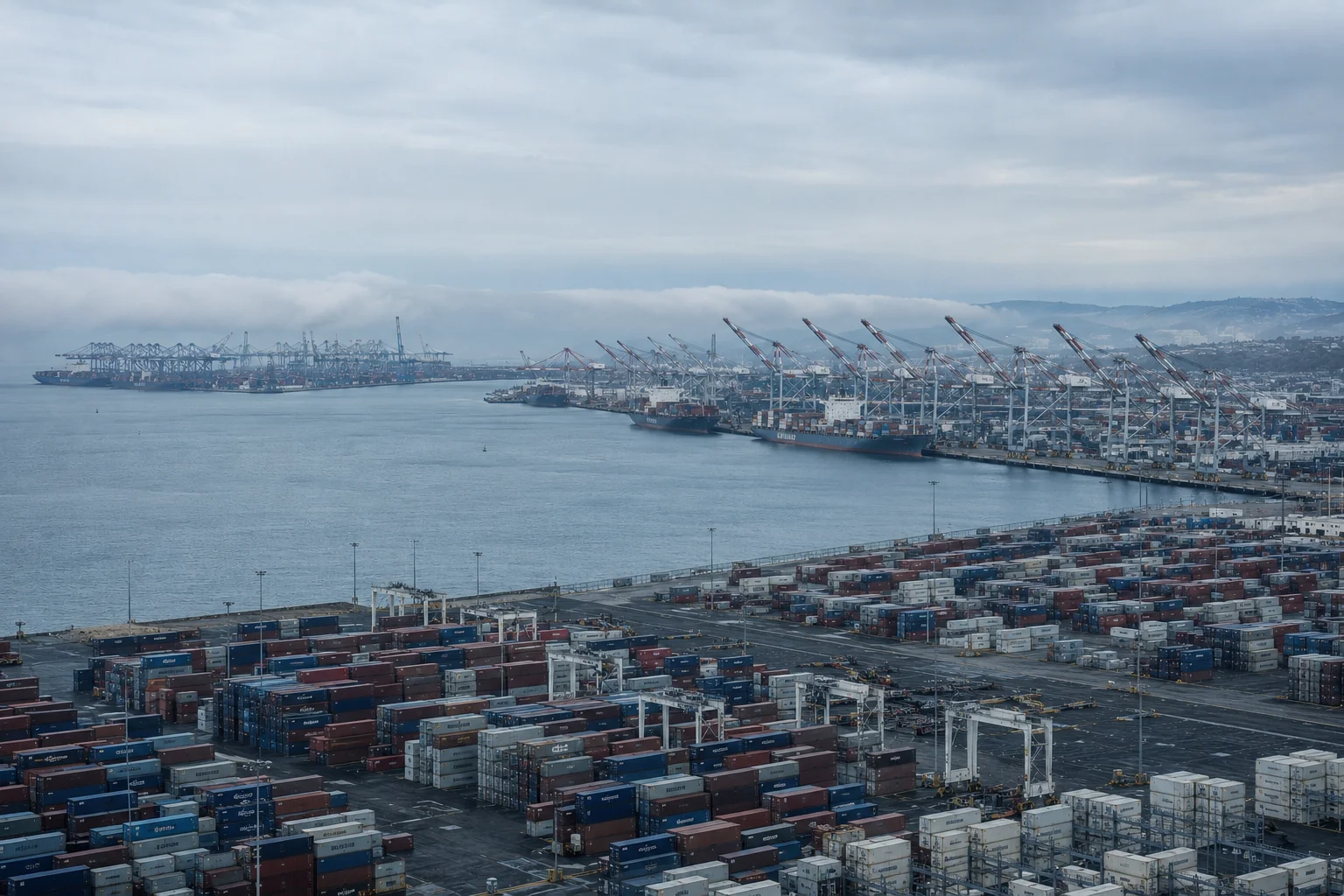
We file entries for cargo arriving at the Ports of Los Angeles and Long Beach, the twin gateways on San Pedro Bay. It is one of our two primary ports. The volume moving through here means the system works well when it works, and that congestion, once it starts, takes far longer to clear than importers expect.
Key takeaways
- Two separate port authorities operating side by side on one bay.
- The largest container gateway in the United States, with the congestion cycles that follow.
- Much of the cargo is transloaded rather than delivered in the original container.
- On-dock and near-dock rail moves cargo inland before it is ever unpacked.
- Examination referrals and equipment shortages compound quickly at this scale.
At this port
Two ports, one bay, separate rules
Los Angeles and Long Beach share a harbour and very little else administratively. They are distinct authorities with distinct terminals, and a container is subject to whichever one it discharges at.
For an importer this mostly surfaces as inconsistency. Gate programmes, appointment systems and off-peak arrangements are not uniform across the complex, and an assumption carried over from one side does not necessarily hold on the other.
Scale cuts both ways
In an ordinary week this is the most efficient way to bring goods into the United States. There is capacity, there are carriers, there is rail, and there are more service providers competing for the work than anywhere else in the country.
When it backs up, the same scale works against you. Congestion here does not resolve in days. Vessels queue, terminals fill, equipment goes missing from where it is needed, and the recovery takes considerably longer than the disruption did. Importers who plan for the good weeks and not the bad ones get caught by this repeatedly.
Transloading, rail and where your goods actually go
A large share of cargo arriving here never travels inland in the box it arrived in. It is transloaded near the port into domestic equipment, or moved by rail from on-dock and near-dock facilities toward inland distribution.
This matters for clearance because it adds a step that has to happen after release and before delivery, with its own scheduling and its own cost. An entry that clears cleanly can still sit if the transload slot is the constraint.
What we do here and what we don't
We are the customs broker of record. We classify, file, manage the FDA side, and coordinate examinations, held cargo and release.
Transloading, drayage, rail arrangements and warehousing run through vetted partners rather than through us. Formal appeals and legal proceedings are outside brokerage scope, and at that stage qualified legal counsel is the right resource.
How it works
-
01
Confirm vessel and terminal
Which of the two ports, and which terminal, before arrival.
-
02
File the entry
Classification, valuation and any agency filings required.
-
03
Watch the release
Customs release, FDA review, and any examination referral.
-
04
Coordinate the onward move
Transload, rail or direct delivery through partners.
-
05
Close the file
Documentation retained and anything outstanding resolved.
Common mistakes
- Treating the two ports as interchangeable. They are separate authorities with separate practices.
- Planning only for a normal week. Congestion here recovers slowly once it starts.
- Forgetting the transload step. Release is not delivery when the box is being stripped near the port.
- Missing ISF ahead of loading. The exposure begins before the vessel sails.
- Leaving FDA requirements to arrival. The review is part of the entry, not a later stage.
Questions
Do you have an office in Los Angeles?
We are a licensed brokerage filing under a national permit, and this is one of our two primary ports. Physical handling — drayage, transload, examination moves — runs through vetted partners at the port.
Which port will my cargo arrive at?
That depends on the carrier and the service. The bill of lading and arrival notice will name the terminal, and the terminal determines a good deal of what follows.
How does congestion affect my clearance?
It rarely affects the entry itself. It affects everything after release — appointments, equipment, transload slots — which is where importers actually lose time and money.
Can you arrange transloading?
We coordinate it through vetted partners. We are the customs broker of record rather than the operator, and we would rather be clear about that than imply otherwise.
Do you handle FDA-regulated cargo here?
Yes. Prior notice, entry review, sampling and held cargo are handled the same way regardless of coast.
What do you need from me to start?
Commodity, origin, port and arrival date is enough for a clearance quote and a note on anything likely to hold the entry up.
Related
Tell us what you're importing.
Commodity, origin, port and arrival date is enough to start.